Heads up: some links on this page are affiliate links. That means if you buy something through one of those links, Aunt Mellie may earn a small commission — at no extra cost to you. She only recommends stuff she actually believes in. See the full Disclaimer for details.
Most candle magic guides dump a spell in your lap and call it teaching. They skip the part that makes any of it actually work. These five practices are what build real candle magic: the relationship with fire, the color knowledge, the oils, the symbols, and the respect for what you’re working with. Get these in place first. The two candle magic spells for beginners at the end will land a hell of a lot harder when you do.
How Do You Get to Know a Fire Spirit?
Fire is a living element; not a metaphor, not a poetic framing, but a presence with its own character that responds to how you show up for it. Every tradition that has actually worked with it (not just written about it) treats it this way. If your candle spells have been landing flat, this is probably why. You’ve been treating fire like a prop.
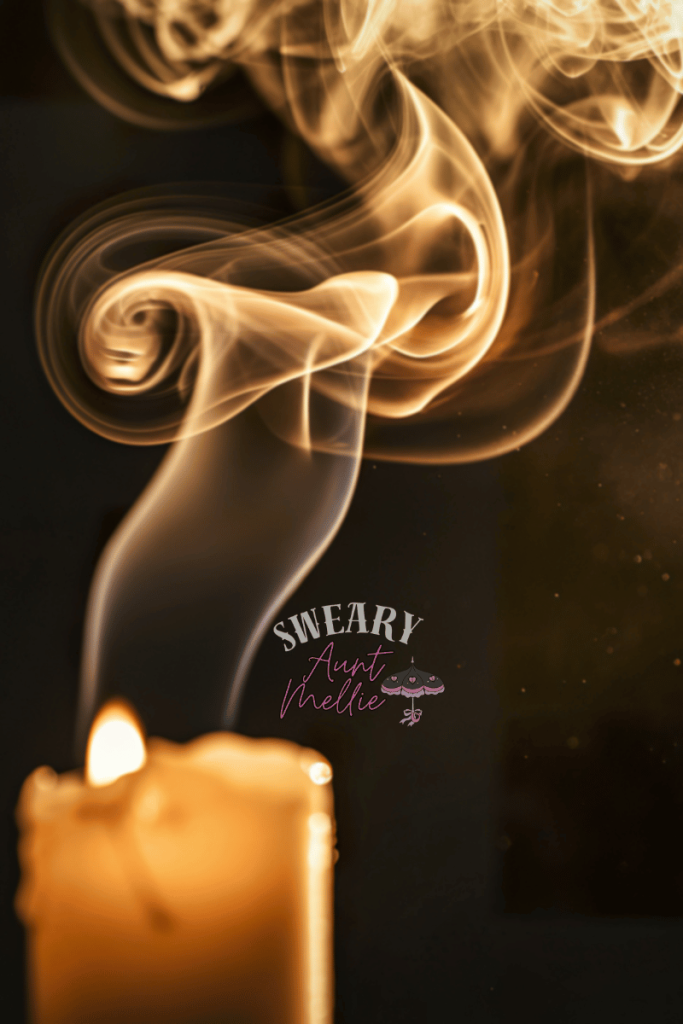
Dim the room. Light a single candle. Sit close enough to feel the warmth on your face and look at it, really look. Notice the colors inside the flame: the blue at the base, the white at the core, the orange and gold at the tips. Notice the shape and the rhythm of its movement. A flame that burns tall and steady is fire in a settled, cooperative state. One that flickers and pulls sideways is responding to something, whether that’s a draft, your own scattered attention, or something in the space. Pay attention to the difference. Don’t meditate on it; don’t journal about it. Just observe without trying to make it mean something right away.
Then tell it it’s beautiful. Out loud, not in your head. Ask it to partner with you. I know exactly how that sounds. Do it anyway and notice what happens to your attention. You’re no longer checking a box on a spell checklist; you’re in a conversation. Fire spirits (called salamanders in Western ceremonial tradition) respond to being seen. Treat this the way you’d treat meeting a neighbor for the first time: you introduce yourself, you’re present, you don’t immediately ask for something.
Do this several times before you cast anything with intention behind it. A flame you’ve sat with, spoken to, and genuinely paid attention to will respond differently in spellwork than one you’ve just struck a match to. That difference is the whole point of this practice. The broader foundation for building this kind of attentive relationship is covered in my piece on how to practice magic at home; start there if you’re building from scratch.
Why Does Candle Color Matter in Your Spells?
Color in candle magic isn’t about what looks pretty on your altar. It’s the first layer of intention you build into a spell, and it either amplifies what you’re asking for or muddies it. The associations aren’t arbitrary; they’re so consistent across cultures that researchers have documented them as near-universal. Learn the map. Use it. Track your results against it over time.
Here’s the actual map: white for purification, clarity, and new beginnings (white also substitutes for any color you don’t have, so stop stressing about your limited supply and just start). Red for passion, courage, and urgency. Pink for self-love and gentle healing. Orange for creativity, momentum, and breaking what’s been stuck. Yellow for mental clarity and communication. Green for money, growth, and abundance. Blue for healing, calm, and protection. Purple for intuition and psychic development. Black for banishing, releasing, and protection from negativity. Brown for grounding and the physical world.
Research on shared color associations across cultures confirms that these responses are consistent and near-universal; this isn’t personal taste, and it’s not tradition for tradition’s sake. When you use the right color you’re working with a current that has been running for centuries. When you use the wrong one, you’re working against it and then wondering why nothing moves.
Color combinations are worth understanding too. If you’re working a spell for confident communication about money (a job negotiation, say, or a rate increase conversation), burning yellow and green together isn’t overkill; it’s precision. You’re not limited to one candle per working. As your practice develops, so will your sense of how to layer color intentionally rather than just picking one and hoping for the best.
Keep a written record. Every candle you burn for a specific purpose: the color, the intention, and what shifted in the weeks after. Do this consistently and you’ll have real data on what lands for you personally, where your associations differ from the standard map, and which intentions need more than one session to actually move. Stop flying blind and start building something you can learn from.
How Do You Anoint a Candle Before a Spell?
Anointing a candle means working plant or oil energy into the wax before you light it. You’re building the spell from the outside in, encoding the intention before the fire gets involved. Making your own oil matters more than people realize. When you chose those specific ingredients for that specific purpose, you were already doing magic; the act of choosing and combining with intention is part of the working, not just the preparation for it.
Direction matters and it is not complicated. Base to tip draws energy toward you. Tip to base pushes it away. Abundance and money spells: base to tip. Releasing and banishing: tip to base. That’s the whole rule. Stop second-guessing it.
For an abundance oil, use orange zest, clove oil, and cinnamon (all three if you have them, any one if you don’t, since each adds a distinct layer). Orange brings abundance and growth. Clove brings heat and urgency, that particular sensation of something already arriving rather than something you’re still waiting on. Cinnamon brings luck in motion, acceleration. As you work each ingredient into the wax, say thank you out loud: thank the orange for the abundance already on its way, the clove for the heat of its arrival, the cinnamon for the luck already moving. You’re saying thank you for a success that has already happened. That is the frame, and both your nervous system and your magic respond to it the same way.
Build out a small collection over time: a purification oil (sage and cedar, or salt water if that’s what you have access to), a protection oil, a clarity oil for decisions that need cutting through. The practice gets sharper the more you make things and actually use them, rather than buying pre-blended oils from someone who has no idea what you’re working toward.
What Symbols Can You Carve Into a Candle?
Carving a symbol into a candle puts your intention directly into the body of the spell. As the wax burns, it releases what you carved into it. One word, one symbol, a short phrase at the absolute most. You’re not writing a letter; you’re carving a charge into wax. Keep it tight or it means nothing.
Runes are one of the most direct options available, particularly if you don’t already have an established symbol system in your practice. Fehu (ᚠ) for wealth and earned resources. Tiwaz (ᛏ) for justice and right action. Berkano (ᛒ) for growth and new beginnings. Algiz (ᛉ) for protection. Hagalaz (ᚺ) for disrupting a stuck pattern (use that one carefully; it’s not subtle and it will shake things loose whether you’re ready or not). Use the rune that actually matches what you’re asking for. Don’t carve Fehu on a protection spell because it’s the symbol you already know how to draw.
Alchemy symbols and traditional witch marks work the same way: the classical elemental markers (fire as △, earth as ▽), planetary symbols for workings that align with specific energies, protection glyphs with centuries of documented use. These systems are not obscure; they’re well-documented and findable. Look up what a symbol actually means before you carve it into something you’re about to burn with intention behind it. That is the bare minimum of respect for the practice.
A sigil is a custom symbol you build yourself from the letters of your intention. Write the intention as a phrase, remove the repeated letters, and collapse what’s left into a single interlocking shape that feels complete to you. Burn the written phrase. Carve only the sigil. The mechanism is that you’ve already encoded the intention in the act of making it; the symbol carries it forward without your conscious mind getting in the way and second-guessing everything. Sigils are worth learning because they let you work with any intention, not just the ones that map neatly onto existing symbol systems.
What Does Respecting Fire Actually Mean in Candle Magic?
Fire is the most powerful transformation element in this practice. It is also the least forgiving of carelessness, and it does not care that you were just experimenting or seeing what would happen. Respect isn’t ceremony or spiritual etiquette; it’s understanding what you’re actually working with before you point it at your life.
Never blow out a fire spirit. Not once, not when you’re in a hurry, not when it seems like a small thing that won’t matter. Snuff it (use a snuffer, or pinch the wick between your fingers). Blowing scatters the intention and pushes it away from you. Before you snuff it, tell the flame you’re going to. Out loud: “I’m closing this now. Thank you.” Five seconds. Every single time, no exceptions.
The deeper issue: fire produces thorough, decisive change. That means it can burn away things you weren’t ready to release, including shields you’d built for good reasons, protections you’d been holding, patterns that were doing useful work alongside the damage. It can lower wards you weren’t consciously choosing to lower. It can accelerate change at a pace you’d have preferred to manage more gradually. Fire doesn’t negotiate about what it takes or how fast it moves. It burns what you’ve pointed it at, and it finishes what it starts.
Use it when you’re sure. Use it when you’ve thought honestly about what you want to change and you’re genuinely ready for that change to be complete, not partial. When you are ready (and I mean actually ready, not “I think I’m probably ready”), fire is one of the most powerful allies available for this kind of work. It burns the structure of a problem rather than just its surface; it releases what is genuinely done rather than setting it aside temporarily. There’s a reason fire shows up in transformation magic across every tradition that has ever existed. When you mean it, fire will meet you there.
Bonus Spell: How Do You Do a Candle Spell for Purification?
Before you start either spell, remember that the spell is just the working part. You need to understand about the whole ritual.
A purification spell uses fire to burn off what doesn’t belong: stagnant energy, an old pattern, something you’ve been dragging around past its expiration date. You’re not pretending it didn’t happen. You’re deciding you’re done with it. Simple enough to do tonight, real enough to feel it working.
You need a black candle and something to carve with. A toothpick works fine; a nail works fine. Stop shopping for the perfect ritual knife and just start. Carve the name of what you’re releasing into the wax (one word or one short phrase). Light it. Say out loud: “I release what no longer serves me. It burns and it goes.” Then let it burn. Don’t hover over it, but don’t leave an open flame unattended either.
Don’t blow it out; snuff it. Tell it you’re closing the session, then snuff it. Relight it next session and keep going until it’s burned all the way down. When the candle is gone, the work is done. After the final burn, dispose of the wax remnants away from your home: outside, in a trash can that isn’t yours, wherever feels like away. You’re not keeping it.
Bonus Spell: How Do You Do a Candle Spell for Money and Abundance?
This is a spell, meaning one focused working with a specific job to do. Use a green candle. Not gold, not whatever’s closest to hand; green. Green is the color of things actively growing: plants, money, living systems that multiply. You’re not setting a mood. You’re doing a money spell. Get the right candle and get specific about what you want before you touch the wax.
Anoint it first, from base to tip. Orange zest, clove oil, and cinnamon (all three if you have them, any one if you don’t). As you work each ingredient into the wax, say thank you out loud: thank the orange for the abundance already on its way, the clove for the heat of its arrival, the cinnamon for the luck already in motion. You’re grateful for something that has already succeeded. That is the frame you’re working from, and it matters more than the ingredients do.
Carve a prosperity symbol into the wax. Fehu (ᚠ) if you work with runes. The Sri Yantra if that’s already in your practice. A dollar sign if that’s what you’ll actually mean when you carve it. Don’t be precious about which one is more legitimate; carve what you’ll believe.
Then your intention in the wax: one word or a short phrase (not a sentence). “Paid.” A specific dollar amount. The name of the client or opportunity you’re calling in. Place a coin, a written number, or a business card at the base. Light it. Sit with it for at least ten minutes, not wishing but imagining; feel what it actually feels like when the thing isn’t a problem anymore. Repeat across sessions until the candle burns all the way down. When it’s gone, so is the block.
Start One Practice. Do It This Week.
You don’t need all five of these solid before you light your first candle with intention. Start with the fire gazing: dim the room, light a candle, watch it, tell it it’s beautiful. Do that a few times this week. Then add a color choice, an oil, a carved symbol when you’re ready. The practice builds itself if you actually show up for it instead of just reading about it.
The difference between candle magic that works and candle magic that doesn’t isn’t talent, or the right tools, or the right moon phase. It’s whether you did the work. Pick one practice. This week. Pay attention to what shifts in the days after. That’s how you find out what’s real, and it’s the only way to find out.
Frequently Asked Questions
What candles do I need to start candle magic as a beginner?
You don’t need anything fancy. A plain taper or votive candle in the right color works fine — grocery store candles, dollar store candles, whatever you have access to. The candle is a tool. What matters is that it has a real flame, it can burn down safely, and you chose it with intention. Unscented is easier to work with, but scented isn’t a dealbreaker.
Does the size of the candle matter for a spell?
Smaller candles are easier for beginners because they burn down faster and the spell has a clear ending. Taper candles and chime candles (about four inches tall) are ideal — they burn down in one focused session. Avoid jar candles and pillars for spellwork until you’re more comfortable, because they take forever and the energy tends to dissipate before the work is done.
Can I use birthday candles for candle magic?
Yes. Birthday candles are small, burn fast, and work fine for simple intentions. They’re especially good for quick one-time spells when you don’t have time for a multi-session ritual. They’re not ideal for deep releasing work because they don’t burn long enough to hold the space, but for a quick focus or intention-setting, they do the job.
How do I know if my candle spell worked?
It worked if something shifted — in your actions, your thinking, your circumstances, or all three. Magic isn’t usually a lightning bolt. It’s more often that you notice a week later you handled something differently, or an opportunity showed up and you actually said yes to it. Pay attention after your spells. Keep notes if you want to track patterns. The results tend to be quieter than the ritual.
Do I need to say words out loud for a candle spell to work?
Speaking your intention out loud matters because it forces you to commit to something specific. It’s harder to be vague when you hear yourself saying it. That said, it’s not magic words — it’s a tool for focus. If speaking isn’t possible, write the intention and read it to yourself. The mechanism is clarity of intention, not volume.
Disclaimer: The content on this site is for informational and entertainment purposes only. It is not a substitute for professional medical, psychological, or psychiatric advice, diagnosis, or treatment. Always consult a qualified healthcare provider with any questions you may have.
Want more of this? Aunt Mellie writes about crystals, runes, moon cycles, and the brain science of why you keep undoing your own progress. Subscribe to the newsletter and she’ll show up in your inbox with the real stuff — no toxic positivity, no pretension, just what actually works.possible, write the intention and read it to yourself. The mechanism is clarity of intention, not volume.